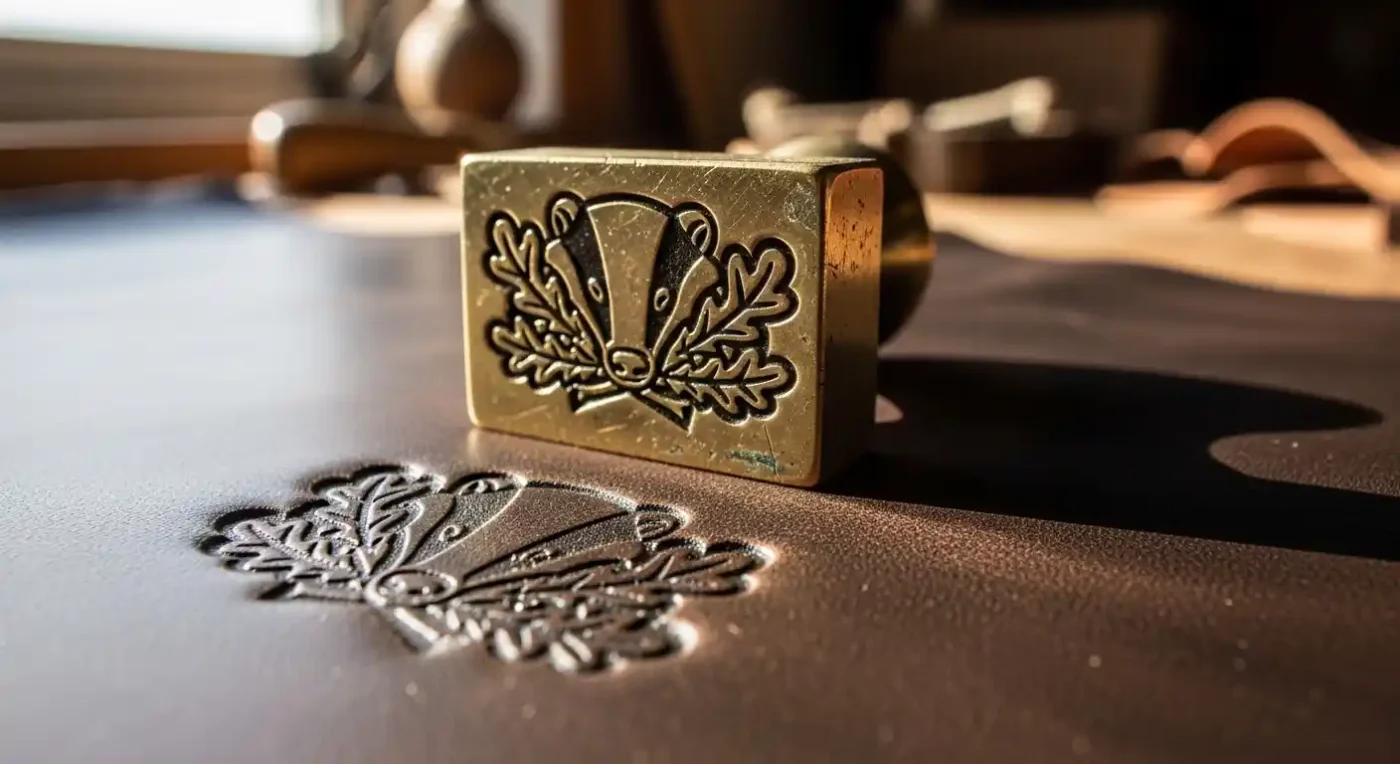

In 2026, the “Buy British” movement has evolved from a simple slogan into a distinct visual identity. UK consumers are suffering from “digital fatigue,” moving away from the clinical, flat aesthetics of the 2010s.
This isn’t just a stylistic preference, recent data confirms that 97% of consumers now cite “authenticity” as a decisive buying factor, with a willingness to pay a premium for brands that prove their human origins.
They are looking for the “Maker’s Mark”—a symbol of authenticity that suggests a product wasn’t just mass-produced, but crafted.
For British artisans, from Sheffield steelworkers to Cotswold potters, your AI-generated logo must embody the weight of history. If your brand doesn’t feel like it has “dirt under its fingernails,” it won’t resonate with the 2026 UK market.
To succeed, you need to move away from “Silicon Valley” sleekness and toward a “Stamp & Seal” aesthetic.
Part 1: The “Hallmark” Aesthetic For UK Makers
In the UK, a hallmark is more than a logo; it’s a guarantee of quality that dates back centuries. The 2026 design trend focuses on “The Impression”—the idea that a logo should look like it was physically stamped into a material rather than just rendered on a screen.
When prompting for hallmarks, focus on Physicality and Imperfection. AI often tries to make things too perfect; you must explicitly tell it to be “weathered” or “hand-stamped.”
- The Master Prompt: “A circular wax seal logo, central icon of a traditional potter’s wheel, weathered stamp texture, ‘Handmade in Sheffield’ circular text rocker, heavy ink bleed effect, rustic terracotta and burnt umber tones, authentic artisan hallmark style, white background, high contrast, 2d vector style –v 6.1”
Part 2: Geography-Specific Visual Cues (UK Regions)
British branding is deeply tied to geography. To dominate the UK search market, your prompts should include regional “anchors.” 2026 is the year of Hyper-Localization, where a business in Cornwall should look fundamentally different from one in the Highlands.
| Region | Key Visual Element | 2026 Color Palette | Cultural Vibe |
| The Cotswolds | Honey-stone manors, lavender, sheep | Limestone, Sage, Soft Cream | Warm, Rural Luxury |
| Scottish Highlands | Thistles, Celtic knots, misty peaks | Heather, Deep Forest, Gold | Rugged, Ancient, Noble |
| Cornish Coast | Rough surf, tin mines, lighthouses | Navy, Sea Salt, Copper | Salty, Artistic, Industrial |
| Northern Industrial | Brickwork, anvils, textile looms | Terracotta, Charcoal, Slate | Gritty, Honest, Hardworking |
Part 3: The “Hallmark” Rule: Legibility at Scale
One of the biggest technical hurdles for UK makers is creating an AI logo that looks beautiful as a full-page image but disappears when printed as a 1cm stamp on a jewelry box or a leather tag.
If your logo looks great on your monitor but turns into a blurry smudge on your browser tab or business card, you are likely dealing with scaling and anti-aliasing issues.
This is a common hurdle for designers using AI tools. We’ve previously broken down Why Your AI Favicon Looks Blurry & Pixelated to help you fix the technical resolution gaps that plague AI-generated graphics at small sizes.
Pro-Tip for Artisans:
Use the “Ink Bleed” Test. When generating your logo, imagine it being dipped in ink and pressed onto paper. If the lines are too close together, the ink would “bleed” and ruin the design. Prompt for “Bold line weight” and “Negative space” to prevent this.
Part 4: Typography of the Isles: Beyond Sans-Serif
In 2026, the UK market is seeing a massive resurgence in Heritage Typography. Forget Helvetica or Roboto. To feel British, your AI-generated text placeholders (which you will later replace in Canva or Illustrator) should imply one of three styles:
- The Woodblock (Industrial North): Heavy, slab-serif fonts that look like they were used in 19th-century factory advertisements.
- The Blackletter (Gothic/Spirit Brands): For breweries and distilleries, use prompts like “intricate gothic blackletter calligraphy” to tap into the “Dark Academia” trend.
- The Gill Sans Influence (Clean British Modern): For high-end London boutiques, a clean, humanistic serif is the way to go.
Part 5: Case Study: “The Highlands Distillery” (Step-by-Step)
Let’s look at how to build a complete 2026 brand identity for a hypothetical Scottish distillery using AI.
- Step 1: The Emblem. Prompt for a “Thistle and Copper Still” in a woodcut engraving style.
- Step 2: The Texture. Add keywords like “printed on heavy-grain cotton paper” or “etched into aged oak barrel.”
- Step 3: The Refinement. Use outpainting to create space for your typography.
Master Prompt for this style:
“Detailed woodcut engraving of a barn owl clutching a sprig of juniper, dark academia aesthetic, intricate fine-line work, vintage parchment background, ‘Peak District Distillery’ in weathered blackletter font, moody and mysterious, high resolution, no 3d renders –ar 4:5”
Part 6: From Pixels to Physical Hallmarks
The final step to a #1 ranking is bridging the “Technical Gap.” Most AI users don’t know how to turn a Midjourney render into a physical brass stamp.
- Upscaling: Use a dedicated AI upscaler to maintain the “grit” without adding digital artifacts.
- Vectorization: Since UK artisans often use CNC machines or laser engravers, you must emphasize that the final output must be converted to an SVG.
- Contrast is King: For physical engraving, a “Level 10” contrast (pure black and pure white) is required. Use the prompt suffix: “–no shadows, –no gradients” to ensure the file is “machine-ready.”







Leave a Comment