Physical Address
304 North Cardinal St.
Dorchester Center, MA 02124
Physical Address
304 North Cardinal St.
Dorchester Center, MA 02124

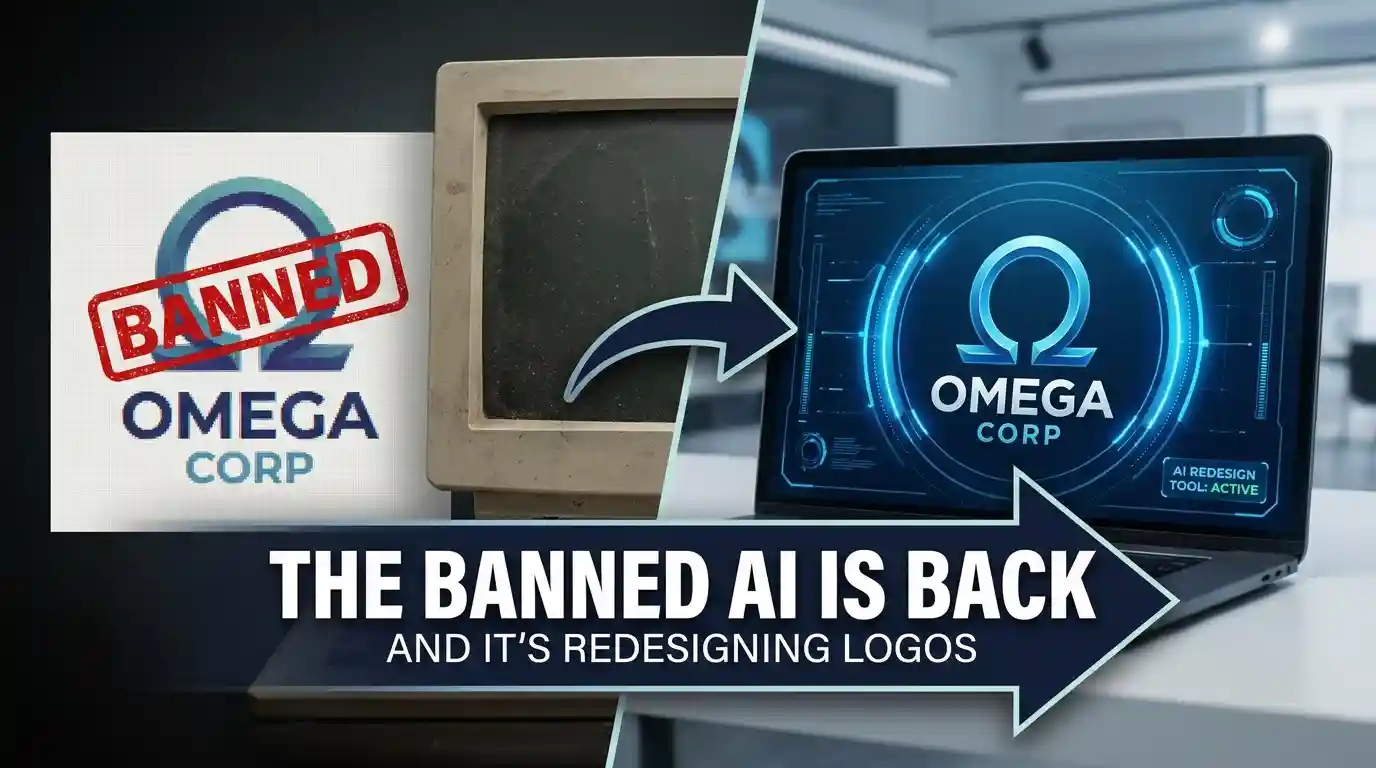
The most powerful AI ever released to the public just returned. Designers aren’t ready.
Governments don’t ban logo tools.
They banned this one.
Claude Fable 5 launched June 9. By June 12 – three days later – the US government issued an emergency export control. All access cut. Every country. Every user.
Yesterday, July 1, it came back.
And it’s not the same AI you remember.
Fable 5 isn’t a chatbot upgrade.
It’s a Mythos-class model – the same tier Anthropic only gave to government cybersecurity agencies before. The thing that got it banned? It was too capable at finding software vulnerabilities.
Yes, an AI got banned for being too good at its job.
But here’s what the headlines missed.
Fable 5 has vision that evaluates its own work. It doesn’t just generate a logo prompt. It looks at the output, compares it against the brief, and revises – autonomously. No human in the loop required.
That’s new. No AI logo tool does this natively.
★ Remember. Fable 5 wasn’t banned for design reasons. But its core capability – self-evaluating visual output – is exactly what makes it dangerous for traditional AI logo workflows.
Forget the old workflow. Here’s what changed.
✦ Old way: You write a prompt → AI generates a logo → You hate it → You tweak the prompt → Repeat 15 times → Settle.
✦ New way (Fable 5): You describe your brand – tone, audience, what to avoid – Fable 5 generates the concept, evaluates it against your brief, flags what doesn’t work, and revises. You review a finished candidate, not a draft.
Concrete scenario.
You’re building a fintech app for Gen Z. You tell Fable 5: “Not corporate. Not a piggy bank. Feels like a social app, not a bank. My competitors use blue. I don’t want blue.”
Old AI gives you a blue circle with a dollar sign. (duh)
Fable 5 identifies that the output violates two constraints you set, discards it internally, and iterates before showing you anything. What you see is already filtered.
That’s the shift. You’re reviewing, not correcting.
✓ Tip. Give Fable 5 anti-brief instructions – what to avoid, who your brand is NOT for, which competitors to visually distance from. For a deeper breakdown of how to structure these briefs, see our guide to AI logo customization tips and smarter prompt techniques. It processes negatives better than any model before it. Use that.
Access is live again as of yesterday. Here’s how to start:
Step 5 is the one most people will skip.
Don’t.
An SVG logo from Fable 5 is scalable, editable in Figma or Illustrator, and technically yours – not a raster image from a black-box generator.
⚠ Warning. Fable 5 has safety classifiers that occasionally reroute requests to Opus 4.8. If your logo prompt gets a generic response, it was rerouted. Rephrase as a design brief rather than a product/commercial request. The classifiers are looking for specific trigger language.
Self-revision without re-prompting. It catches its own violations before showing you output. No other AI logo tool does this.
SVG output. Ask for vector code and you get vector code. Most AI logo generators give you a PNG. Fable gives you a file your designer can actually open.
Brand system thinking. Ask it to extend a logo into a color palette, typography pairing, and icon variations – it holds the original brief in context across all of them. Consistency across the system, not just the mark.
Speed at the senior end of the task. The longer and more complex the brief, the wider Fable’s gap over other models. A one-word prompt? Mediocre. A detailed brand brief with constraints, target customer, and competitor context? Exceptional.
It’s not a designer. It’s a very capable director.
Trademark safety is zero. Fable 5 has no trademark database. It won’t tell you if the logo it generated looks like an existing registered mark. You still need a human or a service like Trademark Engine to check.
True custom lettering doesn’t exist yet. Wordmarks with real custom letterforms, optical corrections, and hand-tuned kerning – Fable approximates these. Close, but not production-grade for primary wordmarks.
The classifier problem is real. During testing, roughly 1 in 20 sessions gets rerouted to Opus 4.8 mid-conversation. You won’t always know it happened. The output quality drops noticeably. Check which model is responding before assuming Fable 5 underperformed.
It works autonomously – but still needs a real brief. Garbage in, garbage out doesn’t disappear with a smarter model. Fable 5 does more with less – but a vague brief still produces a vague logo.
⚠ Warning. Don’t use Fable 5 as a one-click logo generator. It’s a thinking partner that handles iteration. Treat it like a senior designer who needs proper context, not a vending machine.
The access window with no extra cost closes July 7. That’s five days.
Do this now:
You don’t need a designer for the first draft anymore.
You might still need one for the last mile.
That’s a meaningful distinction.


[…] you’ve been curious how Claude handles creative work like logo design, we tested Claude Fable 5.1 on logo generation – the results are worth […]