Physical Address
304 North Cardinal St.
Dorchester Center, MA 02124
Physical Address
304 North Cardinal St.
Dorchester Center, MA 02124

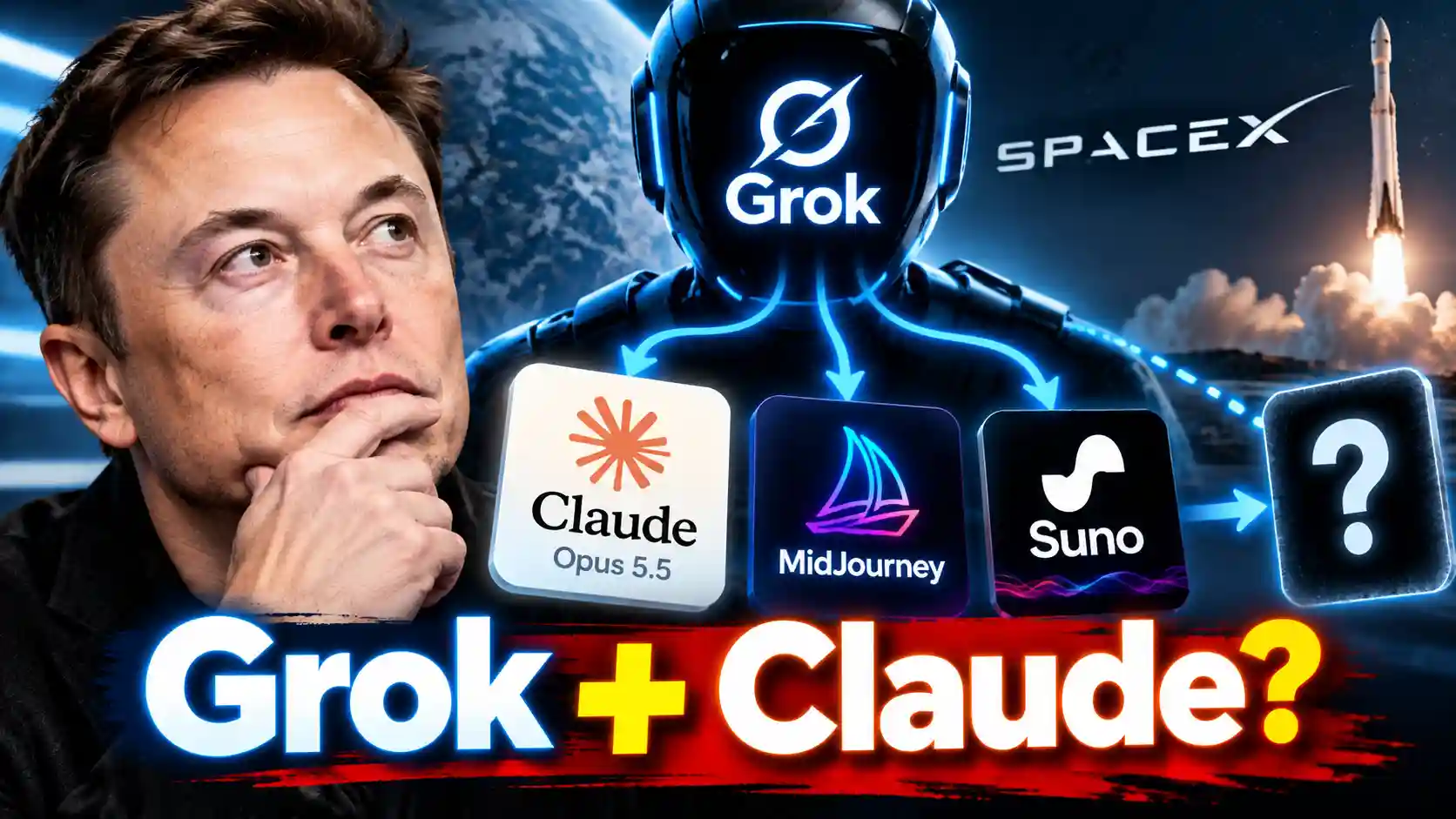
Grok Bot is no longer a single-model product. On October 7, 2026, Elon Musk posted on X that SpaceX will use the best back-end AI model for each task – explicitly naming Anthropic’s Claude Opus 5.5, MidJourney for images, and Suno for audio generation.
“Whatever is most likely to give you the best outcome,” Musk wrote.
That sentence is worth sitting with. Because Musk runs xAI – the company that builds Grok’s own models. This isn’t a neutral product update. It’s an admission that no single model wins every task.
The post was short and direct. Addressed as an “important note regarding Grok Bot,” it confirmed SpaceX would route tasks to leading external APIs when those produce better results.
No partnership terms were disclosed. No pricing. Just a product decision: when an external model outperforms Grok for a given job, that model gets the task.
The tweet pulled 75.2 million views within hours. Reactions split between “finally, outcome-first thinking” and “wait – Musk’s AI company is routing to Anthropic?”
Both reactions are fair.
Claude Opus 5.5 is the top-tier model in Anthropic’s current lineup. It’s built for tasks that demand precision over speed – complex reasoning, dense analysis, structured long-form output, and multi-step problem solving.
(If you’ve been curious how Claude handles creative work like logo design, we tested Claude Fable 5.1 on logo generation – the results are worth seeing.)
Grok’s models are competitive on different ground: real-time X data access, general conversation, and speed-sensitive queries. For heavy reasoning tasks, though, Claude Opus 5.5 consistently shows up near the top of third-party benchmarks.
Routing those tasks to Claude instead of forcing Grok to absorb them isn’t a weakness. It’s the honest call.
Toby Pohlen, who was part of the early Grok team, pointed out that SpaceX used Flux for image generation before the in-house model was capable enough to compete.
“It was decisive in growing the product before the model was ready,” Pohlen wrote on X. “This also sets the bar for the model teams: your model has to beat the competition or it won’t make it into the product.”
That’s a harder internal standard than most AI companies hold. Most platforms stick with their own models – partly for IP control, partly to avoid the optics of outsourcing. SpaceX has done it twice now without blinking.
The interface likely stays the same. The routing happens in the background.
Ask Grok to write a dense legal summary or technical analysis – Claude Opus 5.5 may handle the back-end. Ask for an AI image – MidJourney gets the call. Ask for a generated audio track – Suno.
You’re still talking to Grok. But Grok is now functioning as an orchestration layer as much as it is a model.
Anthony Pompliano made the user-impact case plainly: “A product that won’t route your query to the model best suited to answer is harming the user of the best possible experience.”
He’s right. And most of Grok’s competitors are still doing exactly that.
If Grok Bot increasingly runs on Claude, MidJourney, and Suno for key task types – what is xAI’s actual product differentiation?
The model you access matters less than the layer routing it. We’ve seen this play out in design tools too – ChatGPT has the same problem with certain creative tasks, and specialized models keep winning.
The answer is probably: real-time X data, a persistent always-on agent, and deep integration across SpaceX and X Corp’s infrastructure. None of that requires building the best base model in every category. It requires building the best routing and access layer.
That may be the actual strategic bet here. Grok as an orchestration product, not a model product.
Whether xAI can hold that position long-term – as Claude, GPT-5, and Gemini also build agent layers – is the real question Musk didn’t address.
Robert Scoble’s response – “Grok goes open. Holy shit.” – captures why this feels like a shift.
Most AI platforms treat model lock-in as a competitive moat. SpaceX just treated it as a product flaw.
The AI field is moving fast enough that no single company will lead every task type for long. The products that survive and scale will likely be the ones that route intelligently across the best available tools – not the ones that insist on keeping everything in-house.
SpaceX just made that bet publicly. Whether OpenAI, Google, and Meta follow – or dig in – will define the next phase of the AI product wars.
Follow this space. The model loyalty wars are just getting started.
Yes. xAI’s Grok models remain the default. Claude Opus 5.5 and others are routed to only when they’re better suited for the specific task.
Claude Opus 5.5 is Anthropic’s most capable model as of 2026, designed for complex reasoning, detailed analysis, and high-accuracy generation tasks.
No formal partnership has been announced. Musk’s post describes a product routing decision, not a commercial agreement.
Unknown. Musk’s announcement didn’t mention transparency controls, so routing likely happens silently in the background.
For image and audio generation respectively — areas where specialized models still outperform general-purpose AI systems.
Short-term it’s a concession on model capability in specific areas. Long-term, it may strengthen Grok Bot as a product by removing the weakest outputs from the user experience.